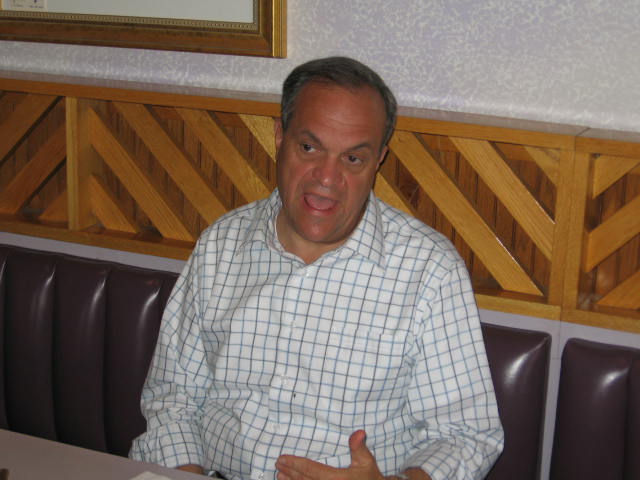
The Town Line Diner in Rocky Hill nestled in a working class neighborhood in a Wal-Mart shopping center typifies the suburban towns that lie along I-91 between New Haven and Hartford. It was here that John DeStefano met with CLP as part of our series on "Meet The Gubernatorial Candidates".
DeStefano, never shy about talking about politics, and what he thinks, opened the conversation with a speech, "just for you guys."
The Big Idea"Good politics is porous, and it's open"
For DeStefano, the son of a New Haven police officer, it has meant a greater accessibility and openness to new ideas on how to tactically change policy. No matter where a question started, DeStefano invariably brought it back public education and how New Haven has brought many different approaches together from community based policing to establishing a "Democracy School" to foster an open, bottom-up, approach to government.
"Everything I thought about making the public schools successful, I just think, it is essential to strong democracy," explained DeStefano. "In New Haven , it meant something called Democracy school, we actually run classes on civic engagement.
He then touched on plans to sign a vendor to create a wireless network in New Haven, making it the first wireless city in Connecticut.
From his stands on community based policing to universal healthcare DeStefano believes in the give and take of the ideas is the path to good governance.
DeStefano acknowledges that much is work in New Haven has been through the efforts of the many people trying different things but always with an eye on building consensus. As DeStefano pointed out whether it was the Sikorsky labor dispute or the Yale labor dispute, the negotiations were a study in understanding human nature.
At times during the wide open conversation, it seemed that DeStefano was running against Hartford instead of the mayor from Stamford, although Malloy was never far from the conversation.
His recent comments about Jodi Rell's proposals addressing the violent crime in Hartford had stirred emotions. He stood by his words though, adding that you "Can't police yourself out of this."
Specifically to Rell's proposals; "Jodi's response is literally that, a 1950's southern response. I don't think she gets it."
DeStefano's experience in New Haven has led him to be much more interested in engaging populations where they are and much more interested in prison relief programs.
Like many good conversationalists, the subject turned to other related issues, and DeStefano pounced on the estate tax.
Criticizing Dannel Malloy and Jodi Rell, DeStefano says its absurd to fix or eliminate the estate tax. To DeStefano there's no linkage between wealthy families and job creation in this case.
DeStefano held more contempt for eliminating the car tax. He explained how he believes that the benefit of eliminating the car tax is exclusive to wealthy people only, providing the anecdote that Greenwich resident, Tommy Hilfiger who owns 21 cars would get the most benefit from eliminating the car tax. What DeStefano does not say is that Greenwich also has one of the lowest car tax rates in the state causing the disparity between the Greenwich Hilfiger often paying less in tax per car than the average 1992 K-Car owner in Bridgeport.
Tomorrow is another day.Echoing the words of Scarlett O'Hara in Gone With The Wind, DeStefano opined, that If you don't get everything you wanted to day, tomorrow is another day. To make a city strong - he spoke to making it safe - making the schools work for the middle class and increasing economic opportunities.
"Your usual small town isn't begging for wal-mart, they just want to make their school budget work, right? Well maybe there's a way to do both. You got to believe in the win-win."
With suburban sprawl DeStefano paints a wistful look at how urban areas and the suburbs can coexist because the urban areas want the density and the suburban areas just want to preserve the character of their towns.
DeStefano bristled at the suggestion that his city still had a reputation that people from the suburbs avoided coming into New Haven.
"The fact is I have school district with 21,000 kids, 1700 of them are suburban kids that come form 21 school districts. I have the largest inner district magnate program in the state of Connecticut."
"People come in each and every day sending their kids to come to public schools in new haven."
"Look at whose renting housing in downtown New Haven."
"There's a generation of kids experiencing New Haven starting at 11 o'clock tonight. They are suburban kids."
But DeStefano's support of the kids coming into New Haven wasn't all that evident just a few years ago where the city of New Haven fought to close down clubs like
The Tune Inn and refused to give permits to local young artist groups like
ideat village. Local merchants too remain wary about DeStefano's new wisdom regarding local businesses, smarting from his strong support to the ill-fated Long Wharf Mall. As for the perception about New Haven it remains,
out there whenever there's talk about the economic benefits of various New Haven festivals.
And when it came to building big box stores, New Haven wasn't the choice of Walmart (Branford), Target (Milford), Best Buy (Orange), Sam's Club or Lowe's (West Haven & North Haven).
DeStefano deserves credit for creating Connecticut's cultural capital, with strong support for education, the arts, and for making New Haven a more enticing and safe city. But his message of regional economic development still isn't reaching his suburban neighbors.
The ghosts of DeStefano's pasts stand in contrast with the DeStefano of the present. The DeStefano of the future though seems headed in the right direction.
"It's time to regional planning and development. You gotta start thinking this way. It's bull that we are paying $5 million a year for Wal Mart, one of the wealthiest corporations on planet earth, not to get way, to get away with not having decent health care for their employees. "
Whether its universal health care or transportation, the issues that drive change must be paid for. To this, DeStefano gave a thoughtful response.
"You have to explain to people why they should care about paying for it. This is not about getting people in Farifield County home earlier at night. It's about growing jobs and wealth."
Jobs cluster around transportation infrastructure ports and then highways. You gotta give people the reason."
"How do you pay for it? One you have to have a governor who doesn't refuse to go down to Washington D.C."
This is where DeStefano of the future broke free from the every day reality of a political record.
"Connecticut in America, has a special role in creating change across the nation. Civil rights laws, or the character of the nations economy. Connecticut has always been the kind of place where things happen --first. It's something we've lost in our politics and in our policy."
"We've had that tradition of being innovators and ingenuity. And we're not anymore. On some social policy we are, right, campaign finance reform... Think about this, in one year, out of the legislature, it didn't come out of the governor's office, campaign finance reform and civil unions."
"We ought to be doing that on redefining the economy."
As he said, "A smart little state like Connecticut does it, makes it work, makes some mistakes, fixes the mistakes, That's Connecticut's gift to the rest of nation, this constant sense of innovation and new ideas."
Whether DeStefano succeeds in his mission to win the Democratic primary on August 8th remains to be seen, but for DeStefano, tommorow will always be another day.
 The sad thing is that Schlesinger's offense doesn't seem all that bad. So he was a card counter. So he played blackjack. Big deal. Card counting isn't illegal, and from his account he wasn't even very good at it. But the Republicans desperately want to run the best candidate they can to capitalize on discontent within the Democratic Party, so Schlesinger, who now has just a whiff of impropriety about him, has to go.