A lot of noise was made about the accuracy of polls and polling methods in the run-up to the election, so it's worth going back and taking a look at the polls to see how closely they match up with the actual results.
U.S. SenateLieberman defeated Lamont and Schlesinger 50%-40%-10%. See the
full list of polls at RealClearPolitics.
Quinnipiac showed Lieberman leading Lamont and Schlesinger 50%-38%-8% (5% undecided) with a margin of error of 3.8% on November 6th. On November 1st, Quinnipiac showed Lieberman leading 49%-37%-8%. The margin of error was 3.2%. An earlier poll on October 23rd, however, showed Lieberman with a 17-point lead.
Rasmussen showed Lieberman leading Lamont and Schlesinger 48%-40%-9% on October 28th, with a 4.5% margin of error. On October 6th, Lieberman led 50%-40%-6%, with a 4.5% margin of error. American Research Group said on October 21st that Lieberman was ahead 49%-38%-8%. The poll had a margin of error of 4%. A Courant/UCONN poll out on October 11th showed Lieberman ahead 48%-40%.
There were a lot of others, including an outlier showing Lamont within 4% from Zogby and another from, well, Zogby showing Lieberman up 20%. But throughout October, Lieberman stayed in the high 40s, brushing 50% at times, while Lamont struggled to break 40%. Schlesinger picked up a few points following the debates, but never got to 10%. The trend that Lamont supporters were hoping for, in which Schlesinger took a significant amount of votes from Lieberman, never materialized. Undecideds broke for Schlesinger, perhaps, but there were so few of them that it hardly mattered. The polls were surprisingly accurate, especially as the election neared.
House RacesThere was a lack of reliable polling information for all of the Congressional races--which seems to be par for the course.
The
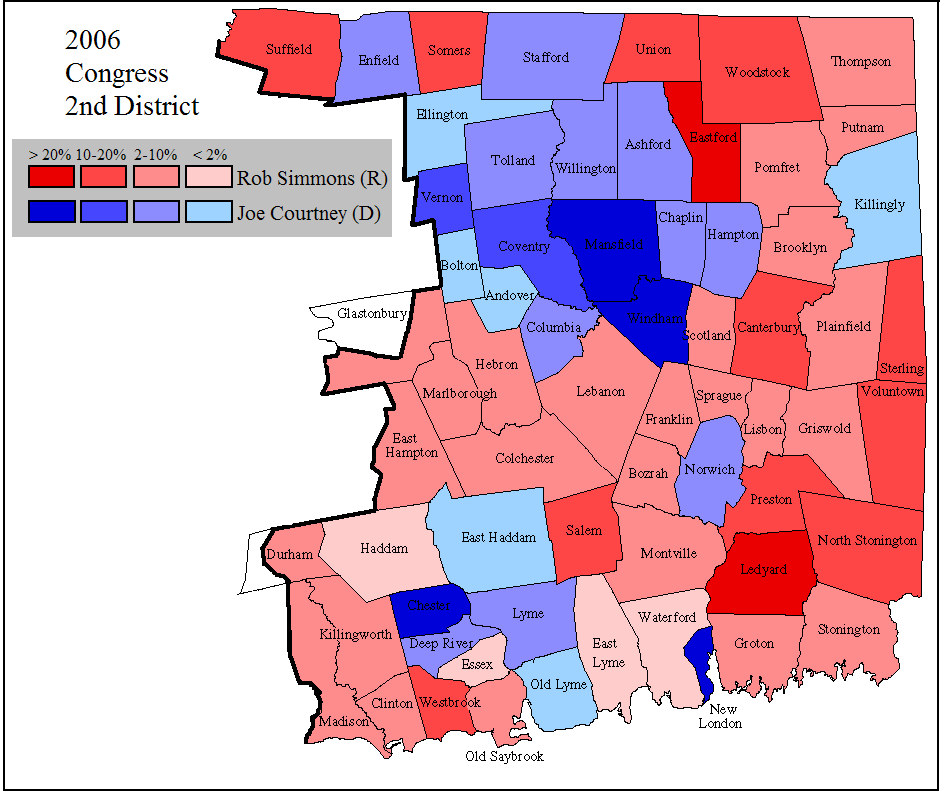
2nd District wound up being the closest Congressional race in the country--and the polls showed it to a point. A Research 2000 survey (the JI-The Day poll) showed the race in a dead heat, with Courtney up by a single point (49%-48%) around Halloween. That poll is the most accurate. Reuters/Zogby had Simmons up by 5% in late October, while UCONN had Simmons up by 2% in mid-October. The polls could never make up their minds on this race--and neither could the voters, apparently.
The 4th District was a surprise win for Chris Shays, mostly because
the polls showed him going down to defeat. Farrell led in the two latest polls by an increasingly large margin. Reuters/Zogby showed her winning by 7% in late October.
Perhaps the place where the polls got it wrong the most was in
the 5th District, where Chris Murphy defeated Nancy Johnson by 12%. No poll forecast this. The closest any poll came to predicting the outcome of this one was a
MajorityWatch (D) poll in October showing Murphy up by 8%. This poll was quickly dismissed as partisan. Republican pollsters had Johnson up by as much as 14% in September. Two independent polls were done at the end of October showing Murphy with a slight lead of 3-4%.
Governor's RaceWell, this one was easy. DeStefano took a Kennelly-esque whomping from Rell, losing to her 63%-35%. No poll quite dared to put her that far ahead, but
all polls showed her up by a wide margin. Basically, all of the undecided voters listed in the polls shown broke for Rell.
So in summary, the polls did a lousy job of determining who would win in the state's Congressional races, but managed to predict with a decent degree of accuracy who would be our next Senator and Governor. This may be because Quinnipiac and Rasmussen, who seemed to be the most accurate, didn't poll Congressional races. Most of the numbers there came from partisan sources The Republican pollsters seemed to do particularly badly in predicting outcomes--if these are the numbers Karl Rove had, it's no wonder he was forecasting a Republican win.
Independent pollsters, with the exception of the obviously flawed Zogby, did pretty well, however.