Calling all Conservatives
Are you a Republican and/or a conservative? Do you have lots of opinions, good writing skills, time to burn and no interest in getting paid?
If so, you may be perfect for the CTLP team. Since Quinn has gone and vanished into the ether, we've been down a conservative. If you feel like helping us restore balance to the blog, send me an email (click on "about" at the top for my address) with your name, location and why you want to blog for us. I'll accept applications through Friday.
Tuesday, June 27, 2006


AFL-CIO Endorses Lieberman
Another labor organization has endorsed Lieberman: this time the mammoth AFL-CIO:
John DeStefano was also endorsed by the AFL-CIO. An interesting sidenote to his endorsment was this release by the Malloy campaign:
This makes me wonder how much the endorsement of a big labor union means. Union membership has fallen from a high of about 20% of the workforce down to about 12%, and it seems like the clout of the unions isn't what it used to be.
Oh, it's still a big deal. A union endorsement means added organization and a bigger get out the vote push. But how much more? How much bigger? How much is a union endorsement actually worth? Can it win the primary for DeStefano and/or Lieberman? How many union members will vote against the endorsed candidate? It'll be interesting to see.
Sources
"News and notes from the campaign trail." Associated Press 27 June, 2006.
"AFL-CIO Convention Statement." Dan Malloy for Governor. Press Release. 27 June, 2006.
U.S. Sen. Joe Lieberman, facing his first Democratic primary challenge as a senator, received the political backing of the state's largest labor organization on Tuesday.
But the AFL-CIO voted only to endorse the three-term senator for the Aug. 8 primary.
That means if Lieberman loses to businessman Ned Lamont, he won't have the guarantee of the labor group's backing should he run as an unaffiliated candidate for the November election...
Tom Swan, Lamont's campaign manager, praised the delegates to the AFL-CIO convention for deciding to make an endorsement only for the primary.
"That's a very, very big deal," he said, adding how it could be a potentially fatal blow to Lieberman in the general election. (AP)
John DeStefano was also endorsed by the AFL-CIO. An interesting sidenote to his endorsment was this release by the Malloy campaign:
Today the AFL-CIO voted to endorse Dan's opponent in the primary. Considering that John DeStefano had this wrapped up six weeks ago and publicly announced it back in May, there was no suspense heading into today, nor was any news made. We expected it, and we have planned for it. But here's what happened that wasn't predicted: the response Dan Malloy received. He was received warmly when he entered, he was interrupted by applause many times while he was speaking, and when he was done half the people in the room gave him a standing ovation, and the other half looked like they wanted to.
Why? It's the same thing that happened as Dan won the Democratic State Convention: Dan makes a great impression on the people in the room due to his energy, his passion, his charisma, his record, and most of all, his ideas.(Malloy AFL-CIO)
This makes me wonder how much the endorsement of a big labor union means. Union membership has fallen from a high of about 20% of the workforce down to about 12%, and it seems like the clout of the unions isn't what it used to be.
Oh, it's still a big deal. A union endorsement means added organization and a bigger get out the vote push. But how much more? How much bigger? How much is a union endorsement actually worth? Can it win the primary for DeStefano and/or Lieberman? How many union members will vote against the endorsed candidate? It'll be interesting to see.
Sources
"News and notes from the campaign trail." Associated Press 27 June, 2006.
"AFL-CIO Convention Statement." Dan Malloy for Governor. Press Release. 27 June, 2006.
Sullivan Doesn't Have to Testify
Decision May Lead to Impeachment
From the formation of our earliest constitution, the Fundamental Orders, until the very end of the 19th Century, the legislature had supreme power in Connecticut. Both the executive and the judicial were de facto subordinates to the General Assembly, although the flawed 1818 constitution technically had separated and equalized them. Only an 1897 court case finally banished that notion for good.
I couldn't blame Sens. Andrew McDonald and Michael Lawlor if they were a little nostalgic, right about now.
Yes, John Rowland was compelled by the Supreme Court to obey a legislative subpoena in 2004 (his resignation short-circuited that), but that was related to an impeachment investigation. This is not. Yet.
It isn't a constitutional crisis yet, I don't think. But this would have been much better had Sullivan simply agreed to testify voluntarily, like other members of the judiciary had.
Source
Tuohy, Lynne. "Jurist Need Not Testify." Hartford Courant 27 June, 2006.
From the formation of our earliest constitution, the Fundamental Orders, until the very end of the 19th Century, the legislature had supreme power in Connecticut. Both the executive and the judicial were de facto subordinates to the General Assembly, although the flawed 1818 constitution technically had separated and equalized them. Only an 1897 court case finally banished that notion for good.
I couldn't blame Sens. Andrew McDonald and Michael Lawlor if they were a little nostalgic, right about now.
Former Chief Justice William J. Sullivan does not have to honor a subpoena to appear before a legislative hearing to answer questions about his decision to withhold release of a controversial ruling to benefit a colleague.
Such an appearance would have violated the constitutional separation of powers doctrine, a Superior Court judge ruled Monday. (Tuohy)
Yes, John Rowland was compelled by the Supreme Court to obey a legislative subpoena in 2004 (his resignation short-circuited that), but that was related to an impeachment investigation. This is not. Yet.
After the hearing, Rep. Michael Lawlor, co-chairman of the judiciary committee, was asked about the prospects of an impeachment inquiry. "It didn't seem like something we were considering yesterday," Lawlor said. "We have to talk to our colleagues about what is the right approach."
Sen. Andrew McDonald, Lawlor's co-chairman, added: "This decision seems to push the legislature toward something we wouldn't do otherwise. ... The whole investigation centers around Justice Sullivan's conduct and state of mind." (Tuohy)
It isn't a constitutional crisis yet, I don't think. But this would have been much better had Sullivan simply agreed to testify voluntarily, like other members of the judiciary had.
Source
Tuohy, Lynne. "Jurist Need Not Testify." Hartford Courant 27 June, 2006.
Mr. Peabody and the Senate Vote Wayback Machine
Now here's something you'll really like, The Washington Post provides a nifty database of votes by Senators along with what the "official" GOP and Democratic Position was. This makes looking at the voting record of a particular Senator crystal clear. Click on the vote itself and see the actual vote totals. Pretty simple.
So what would have happened if the killer bees had Ned Lamont voting in place of Lieberman? The answer is that the vote outcomes would not have changed. Which means that every outrage the killer bees feel would still be an issue. The killer bees would have you think that the actual votes don't matter much, "it's the rhetoric" that matters.
Except that the Democrats as a party have a long history of governing better, a tradition Senator Lieberman is a part of. Governing means actually doing things, instead of just talking about it. The work of a senator includes sponsoring legislation, and amending bills. The committees who control what gets sent on are all are chaired by the members whose party holds the majority, the Republicans. As it turns out, being able to compromise and make deals is a good thing. A senator can't be effective he's not willing to work with his colleagues, just look at Bill Frist as an example.
The killer bees would have you think that this primary vote is about the soul of the Democratic party. It's not, it's about the soap box of the Democratic party.
So what would have happened if the killer bees had Ned Lamont voting in place of Lieberman? The answer is that the vote outcomes would not have changed. Which means that every outrage the killer bees feel would still be an issue. The killer bees would have you think that the actual votes don't matter much, "it's the rhetoric" that matters.
Except that the Democrats as a party have a long history of governing better, a tradition Senator Lieberman is a part of. Governing means actually doing things, instead of just talking about it. The work of a senator includes sponsoring legislation, and amending bills. The committees who control what gets sent on are all are chaired by the members whose party holds the majority, the Republicans. As it turns out, being able to compromise and make deals is a good thing. A senator can't be effective he's not willing to work with his colleagues, just look at Bill Frist as an example.
The killer bees would have you think that this primary vote is about the soul of the Democratic party. It's not, it's about the soap box of the Democratic party.
Monday, June 26, 2006
24-7 Lamont Afternoon Open Forum
Just kidding...
Two pieces of Lamont news:
1. Lamont has a new ad comparing Lieberman to Bush
2. Move On went national in its fundraising appeal for Lamont (and Farrell and Patrick Murphy)
One piece of World Cup news - Australia loses to Italy in the 93rd minute on a penalty kick (the actual flop, I mean, foul, was of the questionable variety) after being up a man for more than 40 minutes. Is it me or are the refs deciding more games than in previous Cups?
Discuss...
Two pieces of Lamont news:
1. Lamont has a new ad comparing Lieberman to Bush
2. Move On went national in its fundraising appeal for Lamont (and Farrell and Patrick Murphy)
One piece of World Cup news - Australia loses to Italy in the 93rd minute on a penalty kick (the actual flop, I mean, foul, was of the questionable variety) after being up a man for more than 40 minutes. Is it me or are the refs deciding more games than in previous Cups?
Discuss...
On Killer Bees and Lamont
In an imaginary conversation with a rational Lamont supporter, I asked them what will happen if the war ended. Well that's not going to happen until Ned Lamont gets to the Senate, they retorted. And of course that's when Newsweek broke the story that a plan drafted by new Iraqi Prime Minister Nouri al-Maliki asked for a time table for US troop withdrawal. Then on Sunday the NY Times touts the leaked plans by General Casey Jr. to reduce combat brigades from the current 14 to 5 or 6 by the end of 2007. This means that the Bush administration is looking for a way out with a quick declaration of victory. Just in time to bolster all those GOP congresscritters who desperately, when not seeking housewives, seek some positive war on terror news or conversely scary news in America to energize some sort of voter pulse.
Meanwhile deep inside the Honeycomb Hideout, the nucifera-roots were busily engaged in typical hive activity. With google as my intrepid guide, I entered "killer bees" as my search term and discovered:
Which brings us to the strange phenomena of what happens when a critical post of Ned Lamont appears. Instead of unique and diverse debate, a chorus of similar posts flood the comments. I suppose this obsession with guarding the hive is important when a candidate can't really differentiate what he would vote on differently than the candidate he's challenging. In a blind vote test, for example, a rational Lamont supporter would not be able to tell the difference between Senator Lieberman's and Senator Dodd's voting records. The difference is that negligible. The only fuel that is driving the Lamont candidacy is Lieberman and his steadfast conviction that for National Security reasons, we must continue our occupation of Iraq and continue the war on terror. Lieberman helps this along by writing and talking about this convictions, not realizing that he's trapped in the no win position of walking into a swarm of angry bees fueled by head hive Daily Kos.
So what happens if Bush out manuoevers Kos, and starts that troop pull out? What will the Lamont candidacy look like? Well, it'll look a lot like Lieberman's. Lamont has yet to define what he would vote on differently than Lieberman. Sure, maybe Lamont would spend more time saying the daily kos talking points, but is that really a good reason to vote for someone? Is that the fundamental rational of a Lamont supporter; that Lamont will echo the daily rants on daily kos? Let the buzz begin.
Meanwhile deep inside the Honeycomb Hideout, the nucifera-roots were busily engaged in typical hive activity. With google as my intrepid guide, I entered "killer bees" as my search term and discovered:
Though their venom is no more potent than native honey bees, Africanized bees attack in far greater numbers and pursue perceived enemies for greater distances. Once disturbed, colonies may remain agitated for 24 hours, attacking people and animals within a range of a quarter mile from the hive.--Attack of the "Killer Bees"
Which brings us to the strange phenomena of what happens when a critical post of Ned Lamont appears. Instead of unique and diverse debate, a chorus of similar posts flood the comments. I suppose this obsession with guarding the hive is important when a candidate can't really differentiate what he would vote on differently than the candidate he's challenging. In a blind vote test, for example, a rational Lamont supporter would not be able to tell the difference between Senator Lieberman's and Senator Dodd's voting records. The difference is that negligible. The only fuel that is driving the Lamont candidacy is Lieberman and his steadfast conviction that for National Security reasons, we must continue our occupation of Iraq and continue the war on terror. Lieberman helps this along by writing and talking about this convictions, not realizing that he's trapped in the no win position of walking into a swarm of angry bees fueled by head hive Daily Kos.
So what happens if Bush out manuoevers Kos, and starts that troop pull out? What will the Lamont candidacy look like? Well, it'll look a lot like Lieberman's. Lamont has yet to define what he would vote on differently than Lieberman. Sure, maybe Lamont would spend more time saying the daily kos talking points, but is that really a good reason to vote for someone? Is that the fundamental rational of a Lamont supporter; that Lamont will echo the daily rants on daily kos? Let the buzz begin.
Bass: "Lieberman Lies"
Paul Bass doesn't like Joe Lieberman. We know that already. But today his ire towards the senator was made much worse by the feeling that the Lieberman campaign had used something he had written as a source for a nasty, inaccurate attack on Ned Lamont.
I really hate to break it to Lieberman, but primary voters just aren't going to accept the idea that Lamont is somehow a tool of the Republican Party. Anyone who actually goes to the polls on a beautiful, hot August day to cast his or her vote for the Democratic nominee for U.S. Senate is more politically aware than this.
Try something else. But do it quick, you're running out of time. And for heaven's sake, don't make Paul Bass any angrier.
Source
Bass, Paul. "Lieberman Lies, Leaps Into Gutter." New Haven Independent 26 June, 2006.
Ask Ned Lamont Why..." the back page begins.
One of the "ask whys" read as follows: "... He Hired The Former Republican Party Chairman To Run His Senate Campaign."
Not true. Connecticut's leading left-leaning Democratic Party activist, Tom Swan, runs the Ned Lamont campaign.
The flyer is referring to someone else, Tom D'Amore. D'Amore ran the state Republican Party in the 1980s. He quit in 1990 to help Lowell Weicker defeat the Republicans and win the governor's office as an independent. D'Amore is a registered independent.
He in no way "runs" the Lamont campaign. The Lamont campaign did hire his firm, Doyle, D'Amore & Balducci (the third named partner being the former Democratic speaker of the Connecticut House of Representatives), to do consulting work.
The Lieberman flyer cites me as a source for this lie: "Source: Paul Bass column, Hartford Courant, 3/26/06."Actually, my column in the Courant that day made no mention of D'Amore working for Lieberman. I did mention in a March 5 Courant column that D'Amore might do consulting work for Lamont.(Update: Bass made a correction on his site--the corrected sentence follows) Actually, my column in the Courant reported that D'Amore had signed on as a consultant, not that he would "run" or "manage" or in any way direct the campaign. (Apologies: Those particular columns are no longer available on the Courant's web site.) On March 13, the Independent did report the fact that D'Amore agreed to sign on as a consultant.
The relevant point is that nowhere was it ever reported that D'Amore would run the campaign. That's a crucial distinction.
...
"For the record," [Lamont campaign manager Tom] Swan said Monday, "I have never been chairman of the state Republican Party." (Bass)
I really hate to break it to Lieberman, but primary voters just aren't going to accept the idea that Lamont is somehow a tool of the Republican Party. Anyone who actually goes to the polls on a beautiful, hot August day to cast his or her vote for the Democratic nominee for U.S. Senate is more politically aware than this.
Try something else. But do it quick, you're running out of time. And for heaven's sake, don't make Paul Bass any angrier.
Source
Bass, Paul. "Lieberman Lies, Leaps Into Gutter." New Haven Independent 26 June, 2006.
Meta-Malloy and Malloy on Education
Meta-Malloy
I first saw Malloy at the Young Dems' RFK dinner in Rocky Hill in October and the circumstances couldn't have been worse. It was a Friday night, it was pouring, Billy Joel (or was it the Boss?) was playing in Hartford, the UCONN Football team had a home game on national TV, and the candidate was driving up from Stamford. What does that equal (I'm looking at you TurfGrrl, Bluecoat, and CGG)? Two hours late. Which was fine, everyone understood, and it could have been a good time to make a few cracks about CT's overburdened transportation system and then work the room. Instead, Malloy launched into his standard stump speech and the remaining 20 or so people came away with the impression that this was an inexperienced gubenatorial candidate.
I had a similar impression a few months later when Malloy came to speak to the UCONN Law School Democrats. Slightly bigger crowd, so it was slightly less odd to launch into the stump speech, but it made for a marked contrast to DeStefano who sat on the edge of a table and had a conversation with us (in fairness, Malloy's event was much better attended because food was served - next year, free food for all events - but we are checking law school IDs, freeloader).
A few weeks ago, my very kind Legislative Councilperson invited me to a Malloy fundraiser in Hamden and I was very impressed. Not an event for the wonkish, Malloy spoke passionately about his background and his vision for CT. Most importantly, coupled with my experience at our meeting on Saturday, it was clear that he had learned something as a candidate: How to connect with his audience.
I am not going to ignite a flame war by declaring Malloy a better candidate to beat Rell (the very definition of an uphill battle right now), especially in advance of a similar meeting with DeStefano, but I will say that my meta-impression of him as a candidate has turned 180 degrees since the first time I saw him last October.
Education
Branford Boy over at My Left Nutmeg has done as all the very great service of transcribing the event; rather than recreate the wheel, I have linked to his transcript of the education portion of the event. Click the link, show BB some love, and hurry back.
Since the fourth wall simply doesn't exist on a blog, you need to know a little about me in regards to education to understand where I m coming from. If you threw a tennis ball into a room filled with my family, you would hit a teacher. And two more on the ricochet. I myself am the product of the NYC public school system, the University of Massachusetts at Amherst (a land-grant public university), Southern Connecticut State University, and now the University of Connecticut School of Law. The last private "school" I went to was in a neighbor's house on Paulding Avenue in the Bronx when I was 5. I believe deeply in the commitment of government to provide quality public education, to all, for free. Public schools are, quite literally, mining our most precious natural resource.
That said, it was very exciting for me to have the opportunity to ask a potential next Governor of Connecticut how he would help the struggling towns and cities to pay for public schooling. His full answer is linked, but I would like to pull out what, for me, is the money quote:
Here are the specifics (as I understand them, I feel confident that Malloy staffers (actual ones, not the everyone-who-doesn't-agree-with-you-kind) will correct any errors I make - I also have put in a request for the wonkiest details I can get - I will write another post when and if I receive them):
-Collect the state's portion of the casino money as agreed and commit it to the development of state's educational system - He pointed out that, unlike property taxes, this revenue source is almost sure to grow (and grow quickly) going forward
-Leave a portion of sales taxes and utility taxes in the community where they are generated and send a portion to a pool for towns that do not generate a large amount of funds via these taxes
-Direct allocation of a portion of the income tax to support localities
-Scrap the ECS funding system and replace it with one that allocates money based on need rather than to make per student funds equal across the state (i.e. acknowledge that it costs more to educate students for whom English is a second language, students with special educational needs, students on free or reduced lunch, and, and this is my own editorializing, transient students who switch school systems mid-year).
Obviously there are some details that need to be fleshed out here (most importantly, I don't see a new revenue source but I see increased funding for schools - how is the difference made up?), but untying educational spending from property taxes (a system of funding that does not adequately fund schools in poorer districts) and reforming the ECS system are ideas that progressives should be able to discuss, refine, and ultimately support.
And that does not even take Malloy's proposal for universal pre-k into account. Ask any teacher (especially in elementary school) what their biggest frustrations are and I guarantee that, somewhere on that list, they will say "kids that aren't prepared for what I am tasked with teaching them". Fixing that begins with universal pre-k.
Luckily for Democrats, there is alot to like about both of our candidates when it comes to educational issues. I am looking forward to asking the same question to DeStefano, but, based on his website, there is more the two of them agree on than not. Which is one reason that I hope this thread wonks-out on educational policy rather than on attacks on the candidates and each other.
Edited for a typo.
I first saw Malloy at the Young Dems' RFK dinner in Rocky Hill in October and the circumstances couldn't have been worse. It was a Friday night, it was pouring, Billy Joel (or was it the Boss?) was playing in Hartford, the UCONN Football team had a home game on national TV, and the candidate was driving up from Stamford. What does that equal (I'm looking at you TurfGrrl, Bluecoat, and CGG)? Two hours late. Which was fine, everyone understood, and it could have been a good time to make a few cracks about CT's overburdened transportation system and then work the room. Instead, Malloy launched into his standard stump speech and the remaining 20 or so people came away with the impression that this was an inexperienced gubenatorial candidate.
I had a similar impression a few months later when Malloy came to speak to the UCONN Law School Democrats. Slightly bigger crowd, so it was slightly less odd to launch into the stump speech, but it made for a marked contrast to DeStefano who sat on the edge of a table and had a conversation with us (in fairness, Malloy's event was much better attended because food was served - next year, free food for all events - but we are checking law school IDs, freeloader).
A few weeks ago, my very kind Legislative Councilperson invited me to a Malloy fundraiser in Hamden and I was very impressed. Not an event for the wonkish, Malloy spoke passionately about his background and his vision for CT. Most importantly, coupled with my experience at our meeting on Saturday, it was clear that he had learned something as a candidate: How to connect with his audience.
I am not going to ignite a flame war by declaring Malloy a better candidate to beat Rell (the very definition of an uphill battle right now), especially in advance of a similar meeting with DeStefano, but I will say that my meta-impression of him as a candidate has turned 180 degrees since the first time I saw him last October.
Education
Branford Boy over at My Left Nutmeg has done as all the very great service of transcribing the event; rather than recreate the wheel, I have linked to his transcript of the education portion of the event. Click the link, show BB some love, and hurry back.
Since the fourth wall simply doesn't exist on a blog, you need to know a little about me in regards to education to understand where I m coming from. If you threw a tennis ball into a room filled with my family, you would hit a teacher. And two more on the ricochet. I myself am the product of the NYC public school system, the University of Massachusetts at Amherst (a land-grant public university), Southern Connecticut State University, and now the University of Connecticut School of Law. The last private "school" I went to was in a neighbor's house on Paulding Avenue in the Bronx when I was 5. I believe deeply in the commitment of government to provide quality public education, to all, for free. Public schools are, quite literally, mining our most precious natural resource.
That said, it was very exciting for me to have the opportunity to ask a potential next Governor of Connecticut how he would help the struggling towns and cities to pay for public schooling. His full answer is linked, but I would like to pull out what, for me, is the money quote:
The big step is to create a new system for paying for public education, one that is far less dependent, if at all, on property taxes. Property taxes make sense in a farming community, because the property produces income. And that's what Connecticut was when this system was devised.
...
So we've got to change that system. And that means a more progressive way of paying for education. Certainly a shift to probably the fairest system, which is an income tax based system, but also identifying other sources to help out both education and general government.
...
Suffice it to say, we've got to change the system, it's gotta be more income based, it's gotta be more progressive in its nature and I think increasingly property taxes have to be looked at as how you pay for your local services, NOT education -- or substantially less to education.
It's a mindset. Other states have done it. I can give you the statistics. We're more dependent than any other state. It's not as if we get it right and 49 states get it wrong. Forty-nine states get it right and we get it wrong. It's time to change.
Here are the specifics (as I understand them, I feel confident that Malloy staffers (actual ones, not the everyone-who-doesn't-agree-with-you-kind) will correct any errors I make - I also have put in a request for the wonkiest details I can get - I will write another post when and if I receive them):
-Collect the state's portion of the casino money as agreed and commit it to the development of state's educational system - He pointed out that, unlike property taxes, this revenue source is almost sure to grow (and grow quickly) going forward
-Leave a portion of sales taxes and utility taxes in the community where they are generated and send a portion to a pool for towns that do not generate a large amount of funds via these taxes
-Direct allocation of a portion of the income tax to support localities
-Scrap the ECS funding system and replace it with one that allocates money based on need rather than to make per student funds equal across the state (i.e. acknowledge that it costs more to educate students for whom English is a second language, students with special educational needs, students on free or reduced lunch, and, and this is my own editorializing, transient students who switch school systems mid-year).
Obviously there are some details that need to be fleshed out here (most importantly, I don't see a new revenue source but I see increased funding for schools - how is the difference made up?), but untying educational spending from property taxes (a system of funding that does not adequately fund schools in poorer districts) and reforming the ECS system are ideas that progressives should be able to discuss, refine, and ultimately support.
And that does not even take Malloy's proposal for universal pre-k into account. Ask any teacher (especially in elementary school) what their biggest frustrations are and I guarantee that, somewhere on that list, they will say "kids that aren't prepared for what I am tasked with teaching them". Fixing that begins with universal pre-k.
Luckily for Democrats, there is alot to like about both of our candidates when it comes to educational issues. I am looking forward to asking the same question to DeStefano, but, based on his website, there is more the two of them agree on than not. Which is one reason that I hope this thread wonks-out on educational policy rather than on attacks on the candidates and each other.
Edited for a typo.
Sunday, June 25, 2006
Dan Malloy: The CEO Governor
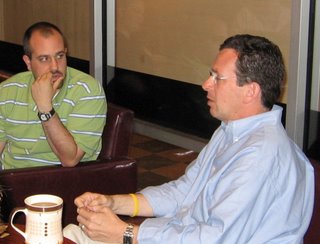
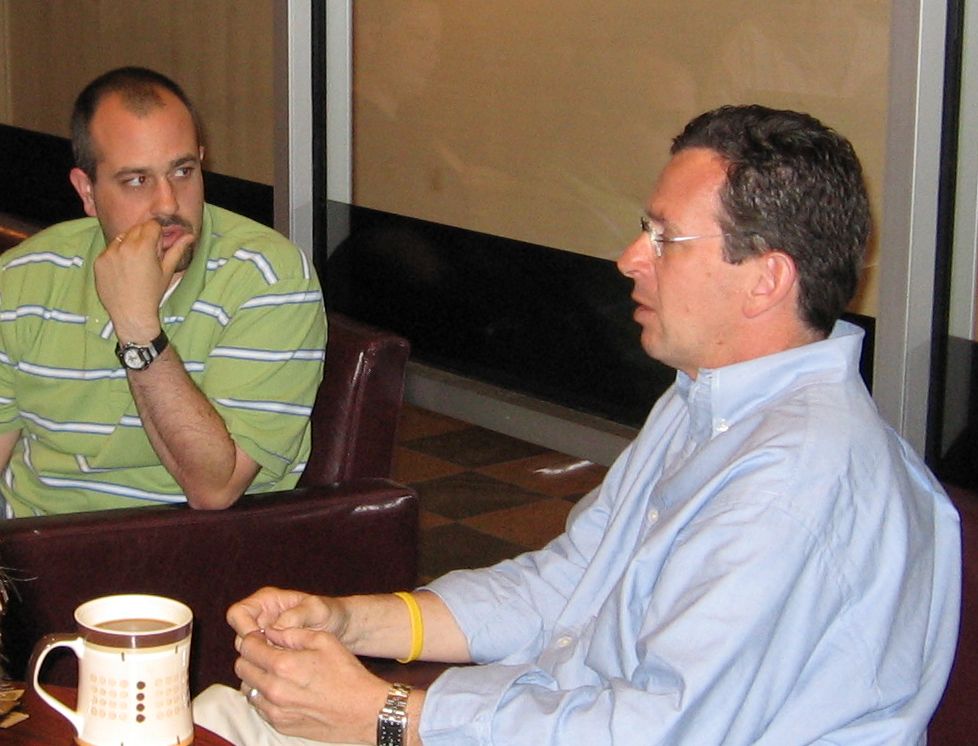
On a rainy Saturday Dan Malloy came to middle of main street in Middletown to chat with some of the political junkies that blog for this site and MyLeftNutmeg at Java Palooza, one of the coffee houses that tap into the free municipal WIFI. Fresh from an earlier “Meet the Mayor” meeting in Stamford, Malloy greeted the small group to talk about his campaign, Connecticut and of course the issues.
In the past six years, Main Street in Middletown has changed from empty store-fronts to a more pedestrian inviting look of small businesses like Java Palooza. It’s the kind of small scale growth that has been a small bright spot for the Connecticut economy recently. In this setting it seemed natural that chatting with Malloy would turn to themes of the Connecticut economy.
“I think Connecticut has some surprising opportunities” said Malloy. “We have the capacity to compete in more areas than people think.”
To Malloy, Connecticut is a land of opportunity, but he admits that he worries more about what happens if Connecticut doesn’t change course.
Connecticut Not Competeting
“Connecticut,” he says softly, “is currently headed in the wrong direction.”
It’s clear that the despite the soft spoken tone, Malloy believes deeply that Connecticut is suffering from years of poor management.
New York, New Jersey and Massachusetts are much more competitive than they were in the past, he explained. New Jersey for example made large investments in their transportation infrastructure and now reap the expansion fueled by rail, water and road investments by the state.
“For the past 20 years, New Jersey has made an investment in transportation, Malloy added, “it’s a sin that Connecticut hasn’t.”
New Jersey’s model isn’t without problems. Legislators in New Jersey are currently grappling with issues concerning over development, cost over runs, and budget shortfalls. But the overall result is hard to argue with. According to James W. Hughes, Dean of the School of Planning and Public Policy at Rutgers “Every period of economic progression in New Jersey was built upon earlier advances in transportation infrastructure investment. These were increments of new transportation capacity that preceded and facilitated subsequent economic growth.”
Connecticut by most measures has not fared as well. A FDIC report from 2005 said Connecticut lagged near the bottom in job creation. Even our farms are closing and moving to Pennsylvania, Malloy pointed out, referring to the recent announcement that Franklin Farms, a grower or organic mushrooms and vegetables is leaving Connecticut.
To Malloy, the list of reasons for the dire outlook of Connecticut’s future is long. “There is no transportation policy. There is no energy policy. There is no job retention, no job growth policy. There's certainly no housing policy.”
Better Government That Costs Less
Malloy points to his record as Mayor of Stamford, not only as a good fiscal model, but also as a model for good governance that communicates better, cuts costs and offers better service.
“This is a good story, a true story,” he begins “In 1995 I went down to Washington D.C. I was trying to get federal funds to improve my city, Stamford. We wanted to add parking, improve the rail stations.”
“They asked me, why doesn’t Connecticut ask for more Federal funds? I couldn’t answer that.” The next year he added a request for 8 rail cars so he wouldn’t be asked the question again. Malloy’s ability to identify problems and work diligently towards solutions is evident in reviewing his record. In 1999, Stamford received $992,500 in federally earmarked funs to start the Stamford Urban Transitway. By 2006, the federal earmarks for Stamford totaled $33,553,00 and the list of projects ranged from high speed ferry terminals, bridges, walking trails and the continued worked on roads and rail improvements.
But federal and state funds aren’t the only places Malloy has looked for ways to fund initiatives. Malloy doesn’t fit the tar brushed mold of what Republicans want people to believe. “We've got to combat this basic rubric of analysis that most citizens engage in, that Democrats are bad for the economy and bad for fiscal management, and that Republicans are good for the economy and good for fiscal management. Now, the reverse happens to be true, but someone's got to be saying this on an ongoing basis, and in my case at least proving it."
Mayors like to tout their city’s bond ratings, in Stamford’s case, still AAA, and then turn to the positives of the yearly budgets. Malloy is no different, he takes pride in his accomplishments, acknowledging that 4 of the past 6 years Stamford has had a budget surplus, but adding with conviction that its 8 surpluses out of nine year's worth of budgets under his watch.
The Future Vision
With the new parking garages and rail station improvements, Malloy turned to the businesses in Stamford to help shoulder part of the investment in making Stamford a better, more attractive place. The result was the downtown special services district contributes money towards the beautification and promotion of downtown Stamford.
“Government should be more proactive on how towns manage their money and their services.” Malloy points out, “Stamford shrunk the size of government but increased services.”
When looking at Connecticut’s rail system, Malloy tackled the outdated thinking that accepts the 100 year old system of fixed passenger schedules. Part of the solution, he says, is to think of it as a subway system with more frequent trains, shorter trains that operate with greater flexibility.
Partnership with business and entrepreneurial approaches do work he explained. “If we wrestled with competition, if government is a partner, there’s a brighter future for Connecticut even in niche manufacturing.”
Yet towns across Connecticut are busy turning industrial zones into residential housing. Malloy is concerned about that, pointing out that he fought to keep a manufacturer in Stamford despite the hard reality that doing business is Connecticut is expensive and often not competitive with other states. He identifies energy costs as one of the many factors that impact business operations using Michigan as an example of a state that offers energy costs about one sixth of what it costs in Connecticut.
Accountability Is Important
Despite Malloy’s enthusiasm for tackling the problems through policy, he came back to a recurring theme. “No one goes back five years later to review policy decisions,” he began, “we do in Stamford.” Malloy, it turns out, is deeply concerned with unintended consequences. It’s not enough for him to craft policy and let others execute it without accountability. That touchstone of accountability is one that resonates broadly, especially for Malloy, a former prosecutor. His view on Jodi Rell’s leadership starkly exhibits his passion for accountability. “She's shocked, she's saddened, she's disappointed in the corruption of people who are working for her.' I mean, we can use the terms, we all know them. This is totally reactive government.”
Malloy is clearly frustrated by the missed opportunities and failures to address Connecticut’s future. He’s hoping for that dynamic to change in November. But he first has to tackle the difficult task of winning the August 8th Democratic primary to get there. He’s itching for a debate with Jodi Rell, “I can’t wait to have a real debate with Jodi Rell,” he says confidently. But when pressed about the campaign for the primary, he admitted his frustrations with the Senate race dominating coverage, and the generally less engaged voter. After the first week of July he promised it’ll be a sprint to the finish. Looking at how he’s tackled each and every task thus far, you can be sure that’s he got a plan to win the race.
In the past six years, Main Street in Middletown has changed from empty store-fronts to a more pedestrian inviting look of small businesses like Java Palooza. It’s the kind of small scale growth that has been a small bright spot for the Connecticut economy recently. In this setting it seemed natural that chatting with Malloy would turn to themes of the Connecticut economy.
“I think Connecticut has some surprising opportunities” said Malloy. “We have the capacity to compete in more areas than people think.”
To Malloy, Connecticut is a land of opportunity, but he admits that he worries more about what happens if Connecticut doesn’t change course.
Connecticut Not Competeting
“Connecticut,” he says softly, “is currently headed in the wrong direction.”
It’s clear that the despite the soft spoken tone, Malloy believes deeply that Connecticut is suffering from years of poor management.
New York, New Jersey and Massachusetts are much more competitive than they were in the past, he explained. New Jersey for example made large investments in their transportation infrastructure and now reap the expansion fueled by rail, water and road investments by the state.
“For the past 20 years, New Jersey has made an investment in transportation, Malloy added, “it’s a sin that Connecticut hasn’t.”
New Jersey’s model isn’t without problems. Legislators in New Jersey are currently grappling with issues concerning over development, cost over runs, and budget shortfalls. But the overall result is hard to argue with. According to James W. Hughes, Dean of the School of Planning and Public Policy at Rutgers “Every period of economic progression in New Jersey was built upon earlier advances in transportation infrastructure investment. These were increments of new transportation capacity that preceded and facilitated subsequent economic growth.”
Connecticut by most measures has not fared as well. A FDIC report from 2005 said Connecticut lagged near the bottom in job creation. Even our farms are closing and moving to Pennsylvania, Malloy pointed out, referring to the recent announcement that Franklin Farms, a grower or organic mushrooms and vegetables is leaving Connecticut.
To Malloy, the list of reasons for the dire outlook of Connecticut’s future is long. “There is no transportation policy. There is no energy policy. There is no job retention, no job growth policy. There's certainly no housing policy.”
Better Government That Costs Less
Malloy points to his record as Mayor of Stamford, not only as a good fiscal model, but also as a model for good governance that communicates better, cuts costs and offers better service.
“This is a good story, a true story,” he begins “In 1995 I went down to Washington D.C. I was trying to get federal funds to improve my city, Stamford. We wanted to add parking, improve the rail stations.”
“They asked me, why doesn’t Connecticut ask for more Federal funds? I couldn’t answer that.” The next year he added a request for 8 rail cars so he wouldn’t be asked the question again. Malloy’s ability to identify problems and work diligently towards solutions is evident in reviewing his record. In 1999, Stamford received $992,500 in federally earmarked funs to start the Stamford Urban Transitway. By 2006, the federal earmarks for Stamford totaled $33,553,00 and the list of projects ranged from high speed ferry terminals, bridges, walking trails and the continued worked on roads and rail improvements.
But federal and state funds aren’t the only places Malloy has looked for ways to fund initiatives. Malloy doesn’t fit the tar brushed mold of what Republicans want people to believe. “We've got to combat this basic rubric of analysis that most citizens engage in, that Democrats are bad for the economy and bad for fiscal management, and that Republicans are good for the economy and good for fiscal management. Now, the reverse happens to be true, but someone's got to be saying this on an ongoing basis, and in my case at least proving it."
Mayors like to tout their city’s bond ratings, in Stamford’s case, still AAA, and then turn to the positives of the yearly budgets. Malloy is no different, he takes pride in his accomplishments, acknowledging that 4 of the past 6 years Stamford has had a budget surplus, but adding with conviction that its 8 surpluses out of nine year's worth of budgets under his watch.
The Future Vision
With the new parking garages and rail station improvements, Malloy turned to the businesses in Stamford to help shoulder part of the investment in making Stamford a better, more attractive place. The result was the downtown special services district contributes money towards the beautification and promotion of downtown Stamford.
“Government should be more proactive on how towns manage their money and their services.” Malloy points out, “Stamford shrunk the size of government but increased services.”
When looking at Connecticut’s rail system, Malloy tackled the outdated thinking that accepts the 100 year old system of fixed passenger schedules. Part of the solution, he says, is to think of it as a subway system with more frequent trains, shorter trains that operate with greater flexibility.
Partnership with business and entrepreneurial approaches do work he explained. “If we wrestled with competition, if government is a partner, there’s a brighter future for Connecticut even in niche manufacturing.”
Yet towns across Connecticut are busy turning industrial zones into residential housing. Malloy is concerned about that, pointing out that he fought to keep a manufacturer in Stamford despite the hard reality that doing business is Connecticut is expensive and often not competitive with other states. He identifies energy costs as one of the many factors that impact business operations using Michigan as an example of a state that offers energy costs about one sixth of what it costs in Connecticut.
Accountability Is Important
Despite Malloy’s enthusiasm for tackling the problems through policy, he came back to a recurring theme. “No one goes back five years later to review policy decisions,” he began, “we do in Stamford.” Malloy, it turns out, is deeply concerned with unintended consequences. It’s not enough for him to craft policy and let others execute it without accountability. That touchstone of accountability is one that resonates broadly, especially for Malloy, a former prosecutor. His view on Jodi Rell’s leadership starkly exhibits his passion for accountability. “She's shocked, she's saddened, she's disappointed in the corruption of people who are working for her.' I mean, we can use the terms, we all know them. This is totally reactive government.”
Malloy is clearly frustrated by the missed opportunities and failures to address Connecticut’s future. He’s hoping for that dynamic to change in November. But he first has to tackle the difficult task of winning the August 8th Democratic primary to get there. He’s itching for a debate with Jodi Rell, “I can’t wait to have a real debate with Jodi Rell,” he says confidently. But when pressed about the campaign for the primary, he admitted his frustrations with the Senate race dominating coverage, and the generally less engaged voter. After the first week of July he promised it’ll be a sprint to the finish. Looking at how he’s tackled each and every task thus far, you can be sure that’s he got a plan to win the race.
Dick Morris: Lieberman Will Lose
Political Wire has a quick quote from Dick Morris about Lieberman's chances:
How similar are these two races? I'll have to look into it.
Source
Goddard, Taegan. "Morris Says Lieberman Will Lose." Political Wire (blog) 25 June, 2006.
"I think Sen. Joe Lieberman (D-CT) will lose the primary and will be so crippled by the defeat and Ned Lamont (D) so empowered, that he will lose the general election as an independent. Sen. Jacob Javits (R-NY), in 1980, could have avoided defeat by not fighting the Republican Primary against Sen. Al D'Amato (R-NY) and running as an independent. But D'Amato was so empowered by the primary win and Javits so disempowered that he won the general election with Javits running a poor third.
"Lieberman's correct course of action is to withdraw from the primary and run as an independent. It is the only way he can get re-elected."
How similar are these two races? I'll have to look into it.
Source
Goddard, Taegan. "Morris Says Lieberman Will Lose." Political Wire (blog) 25 June, 2006.
Malloy on the Primary
Part One of a Series on Dan Malloy
 Bloggers from Connecticut Local Politics and My Left Nutmeg met with Mayor Dan Malloy of Stamford, the endorsed Democratic candidate for governor, on Saturday for an informal question-and-answer session.
Each of the four bloggers from this site who was at the meeting will be providing their take on part or all of the experience. These will not be long articles, as they are intended to allow you to get a basic idea of who Malloy is and what he's about. Today I'll be focusing on some of the horse-race aspects of the meeting, and on my general impressions of Malloy.
The Primaries
Malloy was quick to point to the fact that the Senate primary "is sucking all the air out" of the gubernatorial race. He believes that people are just now starting to pay attention to these races. He's basically looking to July as the real start of the gubernatorial primary: "July through August 8th will be a sprint," he said. Right now "we're in a bit of a lull."
Perhaps the most interesting part of the primary discussion was Malloy's defense of his progressive credentials. When asked about which way Lamont supporters might break, he said, "My hope is that they’ll take the progressive candidate. That’s me."
When civil unions first came up in 2003, he stated, municipal officials were invited to testify in favor of the idea. "Only one showed up. Me." He also said that he "would sign a marriage bill," is "against the death penalty" and, perhaps most importantly to many primary voters, is against the war.
"Where’s John [DeStefano]'s voice on the war?" he asked of his opponent. "I’ve had numerous debates with John. ... I don’t know what his position on the war is. Do you?" (Malloy also defended his membership in the centrist Democratic Leadership Council or DLC--see his remarks here.)
When asked why people ought to vote for him instead of DeStefano, Malloy said "The real difference is that I have a far better record than John [DeStefano] does." He pointed to Stamford's record on crime, ("...one of the 5 safest cities in America"), affordable housing and the economy as points in his favor. He also mentioned that his plan for universal health required the federal government "to pay its fair share" of the cost.
The Convention
"We knew that he didn't have 804 [votes], despite what John [DeStefano] was saying," said Malloy, when asked about his convention victory. He went on to state that the DeStefano campaign "was trying to decieve people," and that "they didn't understand that we had solidified our support."
Malloy said that delegates began changing their votes after the 1st Congressional District was called, "because we won that district" and because they didn't like being decieved. He accused the DeStefano campaign of "typical politics," in which everyone is kept guessing. He referred to the fact that the DeStefano campaign waited until after the votes were done to announce Scott Slifka as their LG choice, and made allusions to the fact that "people in Litchfield" (presumably a reference to Audrey Blondin) were kept guessing. By contrast, the Malloy campaign announced Mary Glassman's selection before the convention began.
Jodi Rell
Malloy, when asked about the remarkably high popularity of Jodi Rell, said, "Everybody in the country thinks that public education needs to be reformed, but they think the public school they send their kids to is great. Think about it.
"I think people in Connecticut have suppressed their true feelings about the failure of government and have decided not to associate that with Jodi Rell because ...she's not John [Rowland] ...and she's a nice person. Therefore, we should like her. And I think that dynamic changes come September."
He repeated several times that the Rell administration has been "a failure."
"I spend more time worrying about what will happen if we don't change directions," said Malloy when asked what he thought a Connecticut following his governorship would be like.
"I can't wait to have a real debate with Jodi Rell," he said.
Commentary
Malloy is a knowledgeable man with a knack for framing the debate. He's also a little more defensive and sharp than I expected, but that may just have been a certain intensity. This is a man who is desperate to wake Connecticut out of what he sees as a bout of self-pity and depression. He believes, strongly, that we can be better than what we are.
The proposal of his that I'm interested in the most has to do with the separation of education funding from municipal property taxes. I'll let someone else talk about this in more detail, but Malloy does at least recognize what may be one of our most serious problems.
Of the two, DeStefano seems like slightly more of a policy wonk than Malloy, but DeStefano has never really played to this strength. His proposals seem less detailed, less concrete and more vague than Malloy's--at least on the surface. There may be more to the DeStefano proposals that we don't see. Actually, there's a lot that we don't see about that campaign. Maybe that's the clearest distinction between the two.
Malloy also may be correct that people have somehow suppressed their feelings about the failure of Connecticut's government--simply because we don't expect much out of government to begin with. This is especially true following the Rowland scandals. I'm not quite convinced that Rell's popularity is due only to mass delusion or to her grandmotherly persona, but that's a discussion for September, not June.
More reactions, reporting and commentary on the Malloy meeting will appear over the next couple of days. Thanks to Dan Malloy and Brian Durand for proposing, setting up and attending this meeting.
 Bloggers from Connecticut Local Politics and My Left Nutmeg met with Mayor Dan Malloy of Stamford, the endorsed Democratic candidate for governor, on Saturday for an informal question-and-answer session.
Each of the four bloggers from this site who was at the meeting will be providing their take on part or all of the experience. These will not be long articles, as they are intended to allow you to get a basic idea of who Malloy is and what he's about. Today I'll be focusing on some of the horse-race aspects of the meeting, and on my general impressions of Malloy.
The Primaries
Malloy was quick to point to the fact that the Senate primary "is sucking all the air out" of the gubernatorial race. He believes that people are just now starting to pay attention to these races. He's basically looking to July as the real start of the gubernatorial primary: "July through August 8th will be a sprint," he said. Right now "we're in a bit of a lull."
Perhaps the most interesting part of the primary discussion was Malloy's defense of his progressive credentials. When asked about which way Lamont supporters might break, he said, "My hope is that they’ll take the progressive candidate. That’s me."
When civil unions first came up in 2003, he stated, municipal officials were invited to testify in favor of the idea. "Only one showed up. Me." He also said that he "would sign a marriage bill," is "against the death penalty" and, perhaps most importantly to many primary voters, is against the war.
"Where’s John [DeStefano]'s voice on the war?" he asked of his opponent. "I’ve had numerous debates with John. ... I don’t know what his position on the war is. Do you?" (Malloy also defended his membership in the centrist Democratic Leadership Council or DLC--see his remarks here.)
When asked why people ought to vote for him instead of DeStefano, Malloy said "The real difference is that I have a far better record than John [DeStefano] does." He pointed to Stamford's record on crime, ("...one of the 5 safest cities in America"), affordable housing and the economy as points in his favor. He also mentioned that his plan for universal health required the federal government "to pay its fair share" of the cost.
The Convention
"We knew that he didn't have 804 [votes], despite what John [DeStefano] was saying," said Malloy, when asked about his convention victory. He went on to state that the DeStefano campaign "was trying to decieve people," and that "they didn't understand that we had solidified our support."
Malloy said that delegates began changing their votes after the 1st Congressional District was called, "because we won that district" and because they didn't like being decieved. He accused the DeStefano campaign of "typical politics," in which everyone is kept guessing. He referred to the fact that the DeStefano campaign waited until after the votes were done to announce Scott Slifka as their LG choice, and made allusions to the fact that "people in Litchfield" (presumably a reference to Audrey Blondin) were kept guessing. By contrast, the Malloy campaign announced Mary Glassman's selection before the convention began.
Jodi Rell
Malloy, when asked about the remarkably high popularity of Jodi Rell, said, "Everybody in the country thinks that public education needs to be reformed, but they think the public school they send their kids to is great. Think about it.
"I think people in Connecticut have suppressed their true feelings about the failure of government and have decided not to associate that with Jodi Rell because ...she's not John [Rowland] ...and she's a nice person. Therefore, we should like her. And I think that dynamic changes come September."
He repeated several times that the Rell administration has been "a failure."
"I spend more time worrying about what will happen if we don't change directions," said Malloy when asked what he thought a Connecticut following his governorship would be like.
"I can't wait to have a real debate with Jodi Rell," he said.
Commentary
Malloy is a knowledgeable man with a knack for framing the debate. He's also a little more defensive and sharp than I expected, but that may just have been a certain intensity. This is a man who is desperate to wake Connecticut out of what he sees as a bout of self-pity and depression. He believes, strongly, that we can be better than what we are.
The proposal of his that I'm interested in the most has to do with the separation of education funding from municipal property taxes. I'll let someone else talk about this in more detail, but Malloy does at least recognize what may be one of our most serious problems.
Of the two, DeStefano seems like slightly more of a policy wonk than Malloy, but DeStefano has never really played to this strength. His proposals seem less detailed, less concrete and more vague than Malloy's--at least on the surface. There may be more to the DeStefano proposals that we don't see. Actually, there's a lot that we don't see about that campaign. Maybe that's the clearest distinction between the two.
Malloy also may be correct that people have somehow suppressed their feelings about the failure of Connecticut's government--simply because we don't expect much out of government to begin with. This is especially true following the Rowland scandals. I'm not quite convinced that Rell's popularity is due only to mass delusion or to her grandmotherly persona, but that's a discussion for September, not June.
More reactions, reporting and commentary on the Malloy meeting will appear over the next couple of days. Thanks to Dan Malloy and Brian Durand for proposing, setting up and attending this meeting.
Saturday, June 24, 2006
Weekend Open Forum
Hey, we made the New York Times! Neat. A note to Gov. Rell: you are welcome on this site at any time.
Local bloggers, including four from CTLP, met with Dan Malloy in Middletown today. Of immediate interest is Malloy's position on the war, which he is steadfastly against. Malloy challenged John DeStefano to make his own position clear. More to come on this interesting meeting.
What else is happening?
Local bloggers, including four from CTLP, met with Dan Malloy in Middletown today. Of immediate interest is Malloy's position on the war, which he is steadfastly against. Malloy challenged John DeStefano to make his own position clear. More to come on this interesting meeting.
What else is happening?
Malloy Blogger Forum
These are a couple of pictures from an informal forum for Bloggers held by Dan Malloy. Four of the bloggers from this site showed up, as did Branford Boy from My Left Nutmeg. Gabe, CGG, Turfgrrl and I will be posting our impressions of the meeting over the next few days.


Friday, June 23, 2006
Lamont on Iraq
Colin McEnroe has an interesting take on what the Lieberman campaign is calling a Lamont flip-flop on the issue of the war.
Democrats in general are shaky on the war. Who can blame them? They didn't really want it, and now they have no idea what to do with it. The only Democrat who seems very, very sure of his position on Iraq is... Joe Lieberman. About the only thing a lot of Democrats can agree on is that Lieberman and the Republicans he was lauded by yesterday are, in fact, wrong. It gets complicated from there.
The "flip-flop" angle is getting some press, and may be the most useful argument Lieberman has come up with against Lamont so far. Not surprising, considering what a story it was in 2004. But whether it'll play with Democratic primary voters--many of whom are similarly conflicted over Iraq and remember the sting of John Kerry being tarred as a flip-flopper by George W. Bush--is an important question.
It could backfire. Deja vu to 2004--with Lieberman in Bush's role. Democrats may end up concluding that Lieberman is just a Republican who can get union endorsements, and turn away from him.
Then again, maybe it'll help him stop his slide. But I have my doubts.
Source
McEnroe, Colin. "The Big Sandy." Colin McEnroe: To Wit (blog) 23 June, 2006.
So Joe has a rock solid position, and I don't. That doesn't make Lieberman right and me wrong. The fact that he has an unwavering position about the biggest military and diplomatic mess in American history since Vietnam -- a mess he helped make and has consistently helped sustain -- does not make him better than those of us who didn't want to this to begin with and now cannot figure out what to do.
He is steadfastly wrong. Lamont is kind of meanderingly right.
Democrats in general are shaky on the war. Who can blame them? They didn't really want it, and now they have no idea what to do with it. The only Democrat who seems very, very sure of his position on Iraq is... Joe Lieberman. About the only thing a lot of Democrats can agree on is that Lieberman and the Republicans he was lauded by yesterday are, in fact, wrong. It gets complicated from there.
The "flip-flop" angle is getting some press, and may be the most useful argument Lieberman has come up with against Lamont so far. Not surprising, considering what a story it was in 2004. But whether it'll play with Democratic primary voters--many of whom are similarly conflicted over Iraq and remember the sting of John Kerry being tarred as a flip-flopper by George W. Bush--is an important question.
It could backfire. Deja vu to 2004--with Lieberman in Bush's role. Democrats may end up concluding that Lieberman is just a Republican who can get union endorsements, and turn away from him.
Then again, maybe it'll help him stop his slide. But I have my doubts.
Source
McEnroe, Colin. "The Big Sandy." Colin McEnroe: To Wit (blog) 23 June, 2006.
Dodd Picks Up $1 Million
Chris Dodd's 2008 presidential campaign raised $1 million at a recent fundraiser.
I think that sounds a lot more impressive than it actually is. Still, this could mean he's at least gaining a little credibility.
And why not? Democrats could do worse than Dodd.
Source
Lightman, David. "Dodd Fundraiser Nets $1 Million." Hartford Courant 23 June, 2006.
Sen. Christopher J. Dodd's presidential campaign raised about $1 million in its first major fundraiser this week.
...
Dodd's greatest need is to come up with a campaign kitty that will be considered viable. In the insular world of early presidential politics, activists look to the money figures as evidence of credibility and support.
Dodd had about $2 million on hand last month, a number which will clearly grow because of the fundraiser. But he still lags well behind others, notably New York Sen. Hillary Rodham Clinton, who has an estimated $20 million on hand, and 2004 Democratic nominee John F. Kerry, who has about $17 million. (Lightman)
I think that sounds a lot more impressive than it actually is. Still, this could mean he's at least gaining a little credibility.
And why not? Democrats could do worse than Dodd.
Source
Lightman, David. "Dodd Fundraiser Nets $1 Million." Hartford Courant 23 June, 2006.
Once Again, Civility
Forcing commenters to register with Blogger hasn't really helped cut down on the personal invective around here. This is sad. I know it's hot out, I know we all disagree (that, in fact, is the point of this blog), but there's no need to heap abuse on others.
So once again let me ask that you leave your political opinions unrestrained, but please check yourselves when heaping personal abuse on another poster. Everyone's entitled to an opinion.
Please don't:
--Call someone an idiot, or another name
--Insult someone else's intelligence, loyalties or beliefs in a personal way (it's okay to disagree, not to insult)
--Make disparaging comments about someone's life outside of blogging
--Make fun of another poster
--Accuse someone of being a staffer for a rival campaign
--Be a jerk
This last rule is the most important.
Now, this post is not aimed at the majority of you, but at a small minority of folks who abuse others constantly. You know who you are. Shape up.
So once again let me ask that you leave your political opinions unrestrained, but please check yourselves when heaping personal abuse on another poster. Everyone's entitled to an opinion.
Please don't:
--Call someone an idiot, or another name
--Insult someone else's intelligence, loyalties or beliefs in a personal way (it's okay to disagree, not to insult)
--Make disparaging comments about someone's life outside of blogging
--Make fun of another poster
--Accuse someone of being a staffer for a rival campaign
--Be a jerk
This last rule is the most important.
Now, this post is not aimed at the majority of you, but at a small minority of folks who abuse others constantly. You know who you are. Shape up.
Lamont: Joining the Ranks of the Flip Flop
By urging the senator to support the less aggressive of the two withdrawal plans - one with no firm deadline - Lamont appeared to back away from comments in recent weeks supporting an immediate withdrawal of U.S. forces from combat.
"I support the Levin-Reed Amendment on U.S. Policy in Iraq, and I urge Senator Lieberman to do the same," Lamont said in a statement posted Wednesday on his website. "It represents the minimum needed, but will build a Democratic coalition to establish and stick to a plan to end the war." Lamont was referring to a proposal by Democratic Sens. Carl Levin of Michigan and Jack Reed of Rhode Island for a phased withdrawal from Iraq beginning sometime this year.
And there you have it, the Lamont who campaigns to the anti-war fringe but actually believes something else.
The Courant Lamont Wavers, Rival Camp Says, June 23, 2006, MARK PAZNIOKAS
Thursday, June 22, 2006
With Friends Like These...
Ann Coulter:
Yeesh.
Source
" Coulter Derides Call For New Iraq Strategy, Endorses Lieberman Approach." Think Progress. http://thinkprogress.org/2006/06/22/coulter-lieberman/. 22 June, 2006.
CAVUTO: So you would admire more at least the politician that says a timetable to get out than going back and forth?
COULTER: No. I would admire a politician, not as much as basically your run of the mill garden-variety Republican, but as far as Democrats go like Lieberman, who apparently does want to defend America and fight the war on terrorism. He is the one facing a primary fight.
CAVUTO: You know, there is talk about him maybe bolting to a third party. The seeds are there for a third party movement. Do you buy that?
COULTER: I think he should come all the way and become a Republican. He wouldn’t be our best Republican but at left he’d fit in with the party that wants to defend the country.
Yeesh.
Source
" Coulter Derides Call For New Iraq Strategy, Endorses Lieberman Approach." Think Progress. http://thinkprogress.org/2006/06/22/coulter-lieberman/. 22 June, 2006.
Judiciary Committee Subpoenas Former Chief Justice Sullivan
The General Assembly's judiciary committee is holding hearings on the scandal surrounding the nomination of Peter Zarella for chief justice. Former Chief Justice William "Tocco" Sullivan, who is very much at the heart of the matter, has refused to voluntarily appear, forcing the committee's leaders to issue a subpoena.
Justice Sullivan's refusal apparently stems from the belief that he cannot be compelled to appear by the legislature. But Sullivan's court decided in 2004 that John Rowland was not exempt from a legislative subpoena (Sullivan dissented).
It will be interesting to see what he'll say, if he shows up.
Source
"Lawmakers Subpoena Former State Supreme Court Chief Justice." Associated Press 22 June 2006.
Judiciary Committee co-chairmen Sen. Andrew McDonald and Rep. Michael Lawlor, said they worked behind the scenes for weeks through intermediaries to convince Sullivan to testify voluntarily, before resorting to their extraordinary power to subpoena such a high-ranking judge.
"Speaking as an attorney, this is a very sad decision we had to make," McDonald said today. "As a legislator, it was an absolutely required decision…Justice Sullivan is at the center of this storm and we cannot dispel the storm without having an opportunity to question him about it." (AP)
Justice Sullivan's refusal apparently stems from the belief that he cannot be compelled to appear by the legislature. But Sullivan's court decided in 2004 that John Rowland was not exempt from a legislative subpoena (Sullivan dissented).
It will be interesting to see what he'll say, if he shows up.
Source
"Lawmakers Subpoena Former State Supreme Court Chief Justice." Associated Press 22 June 2006.
DeStefano Campaign Claims Fake Endorsement
The DeStefano campaign is claiming that the Malloy campaign faked an endorsement by a New Haven union.
From the Malloy press release, earlier today:
And from the DeStefano release a few hours later:
What is going on, here? I find it hard to believe that a campaign would just make an endorsement up.
Update
Brian Durand from the Malloy campaign said the following in the comments to this post:
Someone is not telling the whole truth, here. I have my suspicions about who.
From the Malloy press release, earlier today:
Endorsed Democratic candidate for Governor Dan Malloy, Stamford's Mayor, today received the endorsement of AFSCME Local 1303-393, representing workers at New Haven's Water Pollution Control Authority, in this year's campaign for Governor.
"Dan Malloy understands working men and women, he's the strongest Democratic candidate, and we're proud to endorse him," 1303-393 President Arthur Sandella said. Former 1303-393 Treasurer and current member, Ray Bradley, echoed Sandella's remarks: "Malloy is the clear choice. In my opinion, if you really look at it, his record is better with labor. DeStefano has pushed privatization, and it's hurt a lot of our guys. Malloy's also just a stronger candidate."
And from the DeStefano release a few hours later:
This afternoon Dan Malloy - Democratic candidate for governor – announced that New Haven AFSCME Local 1303-393 endorsed his candidacy for governor. Incredibly, the news release was inaccurate and the Local has not endorsed Malloy. What’s more, Malloy’s release fabricates comments from Local President Arthur Sandella.
Malloy’s news release quotes Sandella as saying, “Dan Malloy understands working men and women, he’s the strongest Democratic candidate, and we’re proud to endorse him.”
Sandella tells the DeStefano campaign today, “I never said that. There was no vote among members or the executive board. There was no endorsement.” As for having the Malloy campaign fabricate comments and attribute them to him, “that’s disrespectful.”
“We understand why the Malloy campaign would be so desperate for support from hard working men and women,” said Derek Slap – Communications Director for the DeStefano campaign – “but this is unfortunate.”
What is going on, here? I find it hard to believe that a campaign would just make an endorsement up.
Update
Brian Durand from the Malloy campaign said the following in the comments to this post:
To be clear...
The union approached the Malloy campaign 2 weeks ago (not the other way around), saying they wanted to endorse Mayor Malloy and hold an event to do so. They wanted to do it at noon today orginally, but then said they were worried because that was on the clock. So, they authorized a press release with the quotes from Mr. Sandella and Mr. Bradley. Our campaign sent out the release.
Some time after we sent out the release our campaign manager recieved a call from a reporter regarding Mayor DeStefano's release.
I think it's obvious what happened today. The union supported Dan Malloy, and once their intentions were public they came under enormous pressure from Mayor DeStefano and his campaign. Frankly it is a shame they had to endure that. However, those kind of tactics did not work for their campaign leading up to the Convention, and I don't think they will work to win this primary.
Someone is not telling the whole truth, here. I have my suspicions about who.
Subscribe to:
Posts (Atom)